
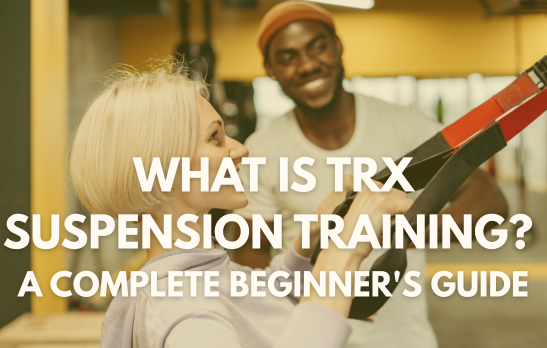
TRX stands for Total Resistance eXercise. It’s a suspension training system developed by a former US Navy SEAL named Randy Hetrick, who originally built a prototype using a jiu-jitsu belt and parachute webbing to maintain his fitness during overseas deployments where equipment wasn’t available.
The commercial version, now used in gyms, military training facilities, physical therapy clinics, and professional sports programs worldwide, consists of two adjustable nylon straps with handles and foot cradles that attach to a single anchor point above you. You use your own body weight as the resistance, adjusting the difficulty of any exercise by changing your body angle relative to the anchor.
The key principle that makes TRX different from almost every other training tool is instability. When you perform a standard push-up on the floor, your hands are on a fixed, stable surface. When you perform a TRX push-up with your hands in the suspension handles, the handles move, and your body has to stabilize against that movement while simultaneously producing force.
This instability forces continuous activation of stabilizer muscles, particularly in the core, shoulders, hips, and ankles, that conventional exercises on stable surfaces largely bypass. Every TRX exercise is simultaneously a primary movement and a core stability challenge.
- Move your feet closer to directly beneath the anchor point → easier (more of your weight is supported vertically)
- Walk your feet further away, increasing the angle of your body → harder (more of your weight is cantilevered, requiring more force to control)
- TRX Push (push-up, chest press, tricep press) → chest, anterior deltoid, triceps, core stability
- TRX Pull (row, bicep curl, face pull) → latissimus dorsi, rhomboids, posterior deltoid, biceps, core stability
- TRX Squat and lunge variations → quadriceps, glutes, hamstrings, adductors, core
- TRX Hip hinge (single-leg deadlift, hamstring curl) → hamstrings, glutes, lower back, core
- TRX Plank and core-specific exercises → rectus abdominis, transverse abdominis, obliques, deep stabilizers
- TRX Anti-rotation and rotational exercises → the entire core in three-dimensional movement patterns
This is the most common question people ask before trying TRX, and the honest answer is that they’re complementary tools rather than alternatives. Here’s how they compare across key variables:
Resistance and Progressive Overload
Free weights have an important advantage in absolute load capacity. You can put 200 pounds on a barbell squat. You cannot put 200 pounds on a TRX squat, the resistance is capped by your body weight. For developing maximum strength and significant muscle hypertrophy, free weights provide a higher ceiling.
TRX compensates partially through angle manipulation and the stabilization demands that increase effective difficulty, but for serious strength athletes, TRX works best as a complement to barbell and dumbbell training rather than a replacement.
Here TRX wins clearly. The instability inherent in suspension training activates stabilizer muscles to a degree that most free weight exercises don’t approach. Research comparing TRX push-ups to floor push-ups shows significantly higher core muscle activation in the TRX variation, even at equivalent perceived effort.
For functional fitness, injury prevention, and sport-specific conditioning, where the body never moves in perfectly controlled planes, TRX’s superior stabilization demands translate directly to real-world capability.
Scalability and Accessibility
TRX is more immediately accessible for beginners than free weights, for two reasons. First, the body weight loading is inherently appropriate for most starting fitness levels, there’s no risk of accidentally loading too much weight. Second, the angle adjustment means a single exercise can be made easy enough for a complete beginner or hard enough to challenge an experienced athlete.
For new exercisers who feel intimidated by the weights section of a gym, TRX provides an entry point to resistance training that feels more manageable and intuitive.
Joint Friendliness
TRX is generally kind to joints. Because you’re always moving through a range of motion that your own body controls, there’s no external load forcing joints into positions they can’t handle. TRX rows and TRX push variations are commonly used in rehabilitation settings for shoulder injuries because they allow strengthening work without the compressive loads of barbell pressing.
People with knee concerns often find TRX squat and lunge variations more comfortable than loaded barbell equivalents, because the suspension allows for more upright torso positioning and reduced shear forces at the knee joint.
The 8 Best TRX Exercises for Beginners
These eight exercises cover all major movement patterns and are appropriate for someone with no prior TRX experience. Start with the easier angle variation and progress as the movement becomes comfortable:
2. TRX Row
Face the anchor, hold handles with palms facing each other, lean back so your body is at roughly 45 degrees. Pull your chest toward the handles while keeping your body in a straight line. This is one of the most important pulling exercises in any program, develops the back and biceps, counteracts the forward rounding that desk work creates.
3. TRX Push-Up
Face away from the anchor, hold handles at chest height, adopt a push-up position. Lower your chest toward the handles and press back up. Adjust difficulty by moving your feet further forward (easier) or further back toward the anchor (harder). The handles moving beneath you make this significantly more challenging than a floor push-up.
Face away from the anchor with feet in the foot cradles, adopt a forearm plank position. The instability of the suspended feet dramatically increases the core demand compared to a standard floor plank. Hold for time. This is harder than it looks.
5. TRX Lunge
Face away from the anchor with one foot in the rear cradle, the other foot on the floor in front. Lower into a split squat position, keeping the front knee tracking over the foot. This develops single-leg strength and hip stability simultaneously.
6. TRX Hamstring Curl
Lie on your back with heels in the foot cradles, hips lifted off the floor in a bridge position. Pull your heels toward your glutes while maintaining hip height, then extend back out. This targets the hamstrings and glutes in a way that most gym equipment struggles to replicate.
7. TRX Bicep Curl
Face the anchor, hold handles with palms facing up, lean back slightly. Curl your hands toward your forehead while keeping elbows high and body straight. Adjust difficulty with body angle.
8. TRX Mountain Climber
Face away from the anchor with both feet in the cradles, adopt a push-up position. Drive alternating knees toward your chest in a controlled, alternating pattern. This is a cardiovascular and core exercise simultaneously, effective finisher for any TRX session.
What a TRX Session at BTTC Looks Like
BTTC’s TRX-45 class is a 45-minute group session that moves through a full-body circuit using TRX suspension trainers. The class is structured for all fitness levels, the instructor teaches both the standard and modified version of each exercise so beginners and experienced participants work side by side.
A typical session includes:
• Dynamic warm-up: 5 minutes of movement preparation, joint mobility, and light cardiovascular activation
• Main circuit: 30 minutes of paired supersets moving through push, pull, lower body, and core exercises
• Cardiovascular intervals: 5 to 7 minutes of higher-tempo work to elevate heart rate
• Cool-down and flexibility: 5 minutes of static stretching and recovery breathing
Is TRX Right for You?
TRX is an effective training tool for a wide range of people, but it’s particularly well-suited to:
• Beginners who want to build full-body strength without navigating the free weights section
• People returning from injury who need low-impact, joint-friendly resistance training
• Athletes who want to improve functional strength, stability, and movement quality
• Anyone who finds conventional gym equipment monotonous and wants a more varied, skill-based training experience
• People who travel regularly can TRX straps pack into a bag and can be anchored to a door, making them one of the most portable and effective training tools available
The one group for whom TRX is insufficient as a sole training method: advanced strength athletes who need maximum loading for muscle hypertrophy or peak strength development. For everyone else, TRX either works excellently as a primary tool or as a highly effective complement to other training.
The most consistent feedback from new TRX participants at BTTC: ‘I didn’t expect it to be that hard.’ Bodyweight training carries an underserved reputation for being easy. A well-designed TRX session is as demanding as any gym workout; the difficulty is just expressed differently.
Getting Started with TRX at BTTC
BTTC’s TRX classes are available as part of the group training schedule at 800 McKenzie Ave, Bellingham, WA. Check the current schedule at betrainingtennis.com/group-training-schedules/ or call (360) 733-5050 to ask about class times and availability.