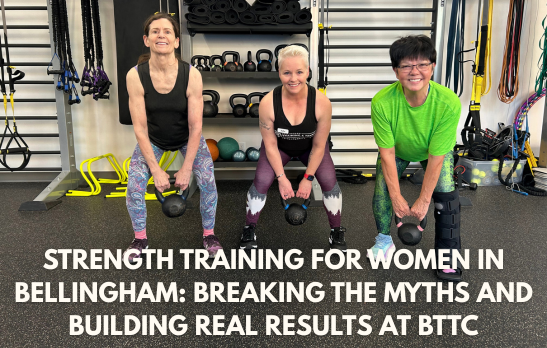
Strength training for women is one of the most misunderstood topics in fitness. Despite decades of research showing its profound benefits, stronger bones, higher metabolism, better body composition, reduced injury risk, a surprising number of women in Bellingham still avoid the weights section of the gym entirely.
At Bellingham Training & Tennis Club (BTTC), we’ve been watching this change for the better. More women are walking into our fully equipped workout rooms, working with our certified personal trainers, and experiencing firsthand what lifting weights actually does for your body. The results speak for themselves, and none of them look like what the myths promised.
This post addresses the most common misconceptions about women and strength training, explains the real science behind the benefits, and shows you exactly how to get started at BTTC in Bellingham.
This is the most persistent myth in fitness, and it’s simply not supported by physiology. Women produce roughly 15 to 20 times less testosterone than men, the primary hormone responsible for significant muscle hypertrophy. Building large, bulky muscle mass requires years of deliberate, high-volume training, extremely high caloric intake, and often pharmacological support. It does not happen accidentally.
What strength training actually does is create lean muscle tissue that makes the body look more defined, not larger, and builds strong bones. Most women who begin a resistance training program report that they feel firmer, look more toned, and that their clothes fit better, not that they’ve gotten bigger.
Cardio burns calories during exercise. Strength training burns calories during exercise AND increases your resting metabolic rate, the number of calories your body burns while doing absolutely nothing. Muscle tissue is metabolically active, meaning more lean muscle means more calories burned around the clock.
Research consistently shows that women who combine strength training with moderate cardio achieve better long-term body composition results than those who do cardio alone. Our personal trainers at BTTC regularly build programs that use both, but the weights are the foundation, not an afterthought.
Machines have their place, especially early in training when you’re learning movement patterns. But free weights, dumbbells, barbells, kettlebells, activate significantly more stabilizer muscles because your body has to control the movement in three dimensions rather than being guided by a machine track.
Exercises like goblet squats, Romanian deadlifts, dumbbell rows, and hip thrusts build functional strength that carries over to real life: lifting, bending, carrying, climbing stairs. Machines can supplement this, but they shouldn’t be the whole program.
Progressive overload, gradually increasing the challenge over time, is the key to strength training adaptation. That doesn’t mean you need to start by lifting heavy weights. It means you need to consistently push slightly beyond your current comfort zone, whether that’s with resistance bands, light dumbbells, or eventually a loaded barbell.
Our certified personal trainers at BTTC assess exactly where you are and build from there. No ego lifts. No comparison to anyone else. Just a logical, personalized progression that moves you forward.
This one may be the most damaging myth of all, because it causes older women to avoid exactly the training they need most. After age 30, women lose approximately 3 to 5 percent of muscle mass per decade without resistance training. After menopause, bone density loss accelerates significantly.
Strength training is the single most effective tool for preserving muscle mass and bone density as women age. At BTTC, we work with women across all age groups, including many members in their 50s, 60s, and 70s who attribute their mobility, energy, and independence to their consistent strength training practice.
Let’s talk about what actually happens when women lift weights consistently. These are not promises, they’re documented outcomes from peer-reviewed research and from the experiences of BTTC members in Bellingham:
- Increased resting metabolic rate: More muscle means your body burns more calories at rest, making long-term weight management more sustainable
- Improved bone density: Resistance training is one of the most effective evidence-based interventions for osteoporosis prevention
- Reduced risk of injury: Stronger muscles protect joints. Women who strength train experience fewer knee, hip, and shoulder injuries than those who don’t
- Better hormonal balance: Resistance training improves insulin sensitivity, reduces cortisol over time, and supports healthy hormone regulation
- Enhanced mental health: Multiple studies link regular strength training to reduced symptoms of anxiety and depression, increased self-efficacy, and improved body image
- Functional independence: The ability to carry groceries, lift your kids, climb stairs without discomfort, all of these depend on muscular strength
Every woman who comes to BTTC for strength training starts with an assessment. Our certified personal trainers, holding credentials from NASM, ACE, NSCA, and similar organizations, evaluate your current fitness level, movement quality, goals, and any injury history before recommending a program.
A typical beginner to intermediate strength program at BTTC might include:
- 2–3 full-body sessions per week, approximately 45–60 minutes each
- Compound movements as the foundation: squat variations, hip hinge patterns, upper body push and pull
- Progressive overload built into the program from week one, not randomized, not guesswork
- Core stability work integrated throughout, not just as an add-on at the end
- Recovery guidance: sleep, nutrition principles, and how to manage soreness
As you advance, the program evolves. More complex movement patterns, higher loads, more specific work depending on your goals, whether that’s aesthetic, athletic, or functional. The trainer doesn’t disappear once you know the basics. They keep the program moving forward.
Both have a place at BTTC, and many members use both simultaneously. Here’s how to think about it:
Group fitness classes, including TRX, our strength-focused sessions, and circuit training available on the group training schedule, offer energy, community, and variety. They’re excellent for motivation, general conditioning, and building the habit of showing up. TRX in particular is one of the best tools for building functional strength using bodyweight resistance.
Personal training is the right choice when you want a program specifically tailored to your body, your goals, and your starting point. If you have specific aesthetic goals, are returning from injury, want to learn how to lift correctly before training independently, or simply want faster results with less guesswork, personal training accelerates all of that.
Many BTTC women do both: one or two personal training sessions per week, complemented by group classes for variety and community.
Gym intimidation is real. Particularly in the weights section. Particularly for women who are new to strength training. BTTC is not a competitive bodybuilding gym or a high-volume commercial chain where the lifting floor feels like someone else’s territory.
We’re a community club. We’ve been serving Bellingham and Whatcom County since 1975, and a significant portion of our membership is women of all ages and fitness backgrounds. Our trainers are approachable, our regulars are welcoming, and our facility is genuinely designed for long-term, sustainable fitness rather than performance theater.
If you’ve avoided strength training because the gym environment felt uninviting, we’d encourage you to come for a free tour and see what BTTC actually feels like. We think you’ll notice the difference immediately.
BTTC is located at 800 McKenzie Ave in Bellingham, WA, serving members from across Whatcom County including Fairhaven, Sehome, Ferndale, Lynden, and beyond. Our fully equipped workout rooms, certified personal trainers, and welcoming community are ready whenever you are.
Call (360) 733-5050 to book a free tour, or visit betrainingtennis.com/personal-training/ to learn more about our personal training programs.
You’ve read enough. Time to lift.